We’ve continued to see floods since June, with changing patterns.


Our 0.4.9.15 observations may be useful context for your 0.4.9.16 report.

Our October 30–November 5 observations show (charts attached):

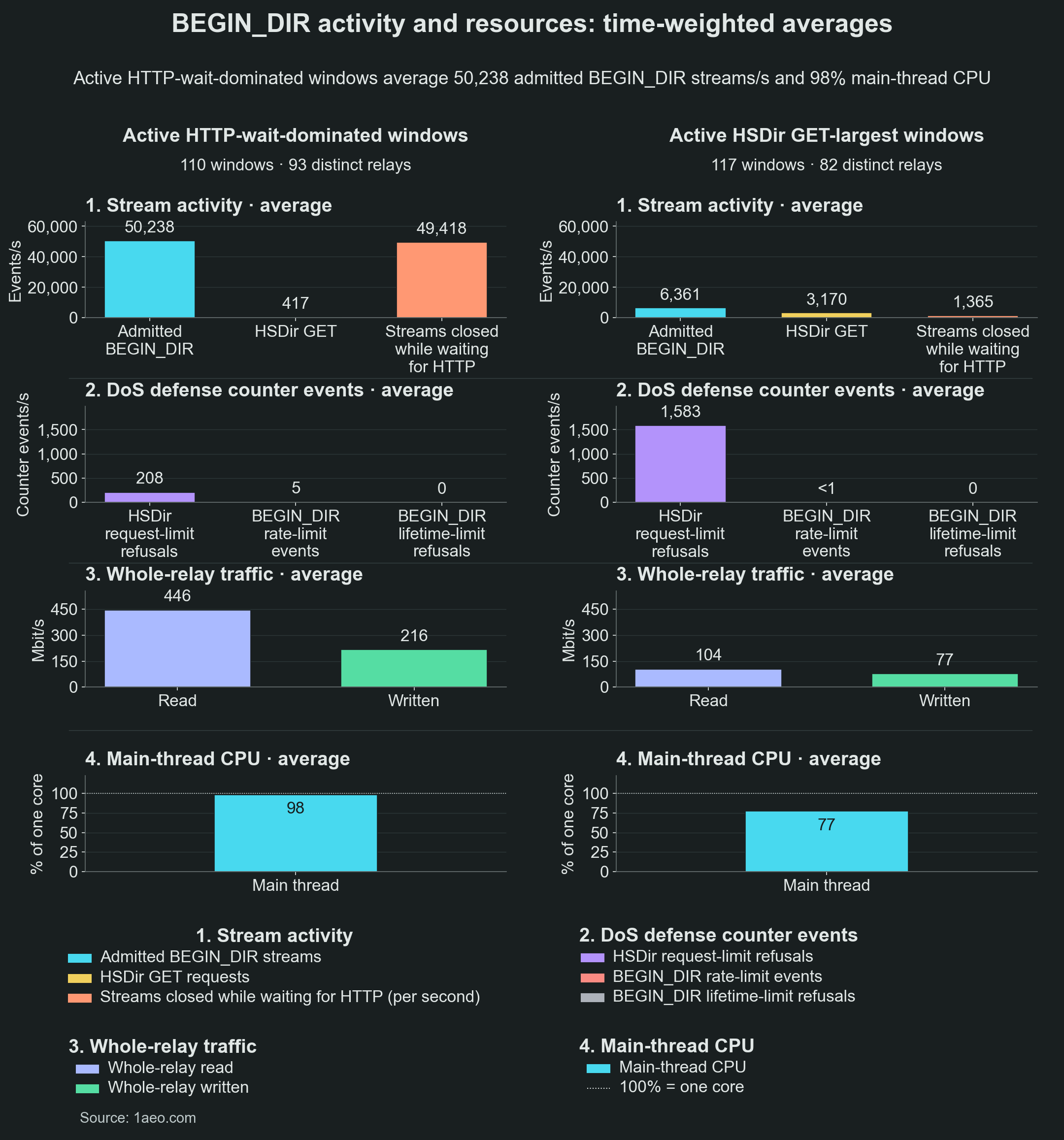
- The HSDir request limit is working: about half of HSDir GET requests were refused across 206 observation windows on 118 relays.

- Heavy HTTP-wait activity remains: 110 active windows on 93 relays averaged about 50,000 admitted BEGIN_DIR streams/s and 98% main-thread CPU, alongside only 208 HSDir refusals/s and 5 BEGIN_DIR rate-limit events/s.

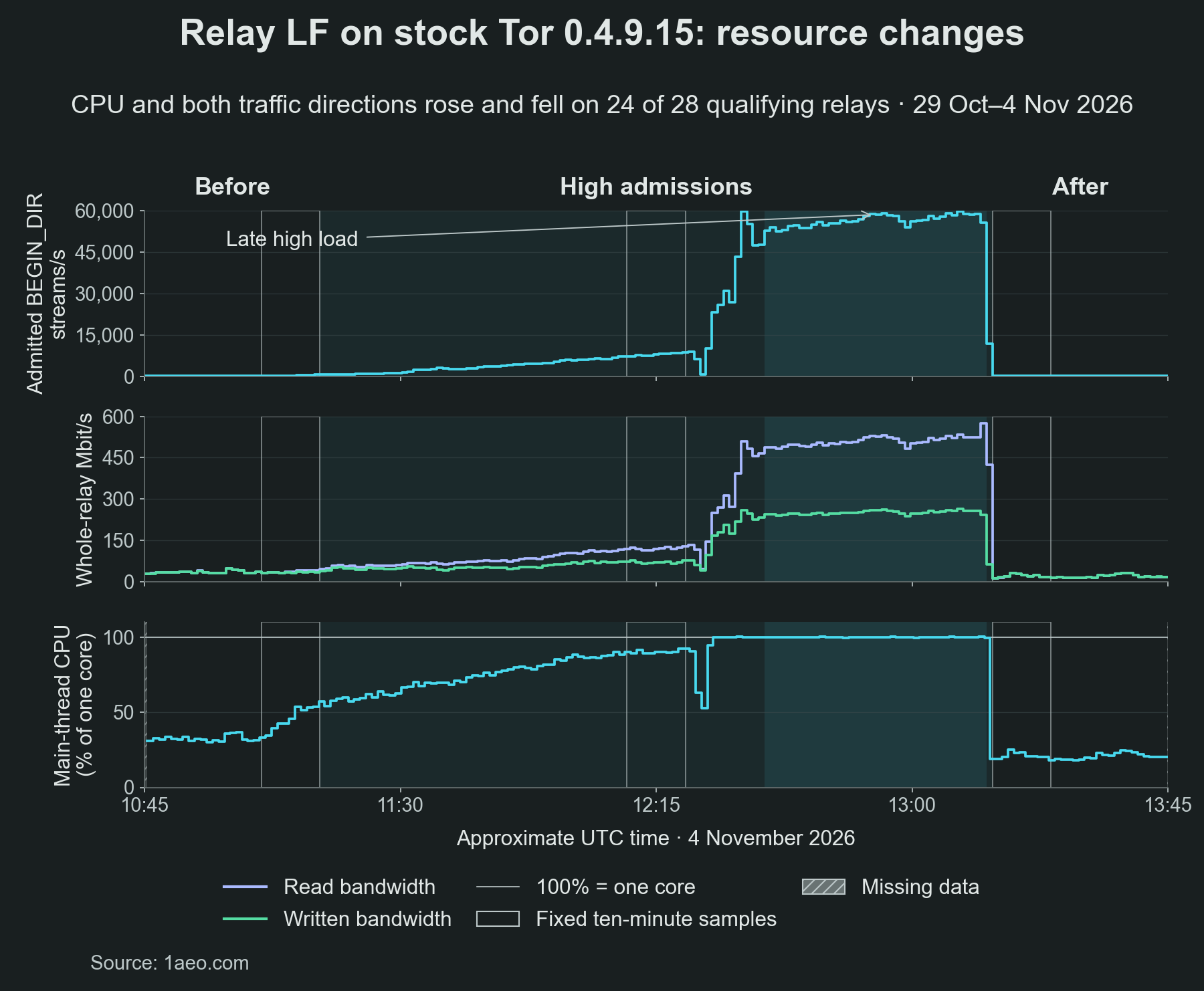
- Stock Tor also remained heavily loaded: Relay LF sustained about 56,000 additional admissions/s and 474 Mbit/s more read bandwidth than before the surge, with main-thread CPU averaging 100%, for about 45 minutes. Across the wider before/during/after sample, CPU and both traffic directions rose and fell on 24 of 28 qualifying relays.

Tor admits directory streams before the per-circuit HSDir request-limit check. The limit helps, but substantial work can occur before it. Relay-wide directory-stream admission controls seem worth testing; we haven’t measured their effectiveness.

Details, methods and charts:
After Tor 0.4.9.15: HSDir refusals and continuing BEGIN_DIR stream pressure

https://1aeo.com/blog/tor-begindir-hsdir-mitigation-pressure.html


On Monday, November 9th, 2026 at 2:13 PM, forest via tor-relays <tor-relays@xxxxxxxxxxxxxxxxxxxx> wrote:

> Hello.
>

> Apparently, the attacker has returned and successfully stripped the
> HSDir flag from two of my relays in a few hours. One attack saw high
> asymmetric egress and one saw high asymmetric ingress (although not
> nearly as much as the old attacks, so total bandwidth stayed about the
> same). Both relays lost their HSDir flags as a result.
>

> The high-ingress attack (100 Mbps in, 15 Mbps out) did not cause any
> noticeable CPU increase but caused my entire swap partition to fill up
> and caused severe thrashing. The high-egress attack (30 Mbps in, 130
> Mbps out) only increased memory usage slightly but pegged the CPU at
> 100% the entire time.
>

> As with the last attack, the MetricsPort and ControlPort become fully
> unresponsive, preventing me from easily collecting diagnostics. I did
> manage to get some metrics from the victim of the egress attack. Some
> relevant samples are:
>

>   tor_relay_traffic_bytes{direction="read"} 74109675909
>   tor_relay_traffic_bytes{direction="written"} 130455336031
>

>   tor_relay_load_onionskins_total{type="ntor",action="processed"} 4345
>   tor_relay_load_onionskins_total{type="ntor",action="dropped"} 64003920
>   tor_relay_load_onionskins_total{type="ntor_v3",action="processed"}
> 5449564
>   tor_relay_load_onionskins_total{type="ntor_v3",action="dropped"} 0
>

>   tor_relay_streams_total{type="BEGIN"} 1
>   tor_relay_streams_total{type="BEGIN_DIR"} 1710223
>

> None of the "tor_relay_dos_total" samples fired. Version is 0.4.9.16.
>

> Is anyone else experiencing this? Are there any mitigations?
>

> Regards,
> forest
Attachment:
image.png
Description: PNG image
Attachment:
image.png
Description: PNG image
Attachment:
publickey - tor@1aeo.com - 0x9288289B.asc
Description: application/pgp-keys
Attachment:
signature.asc
Description: OpenPGP digital signature
_______________________________________________
tor-relays mailing list -- tor-relays@xxxxxxxxxxxxxxxxxxxx
To unsubscribe send an email to tor-relays-leave@xxxxxxxxxxxxxxxxxxxx